Showing posts with label before and after. Show all posts

07 August 2012

Olympic Hurdles on the High Street

A few weeks ago, a colleague of mine forwarded a Daily Mail article detailing the makeover of “tatty” Leyton High Road in East London.  The revitalisation was done in anticipation of the Olympics and the arrival of the torch relay.  These images, from the article, illustrate the transformation:


I won’t elaborate on my reservations about imposing a conservative English village aesthetic on one of London’s most diverse neighbourhoods.  (There's a lot to unpack here!)  Instead, I’d like to focus on the relationships between grooming shopping parades, the presence of corporate brands, and the Olympic trademark.

What I find particularly interesting is how corporate branding is tempered through this revitalisation.  It seems advertising and branding contribute to the so-called “tattiness” of the street.  To spruce things up, the Council evidently clamped down on corporate displays.


The irony here is that with the LOCOG’s tight restrictions on using the Olympic trademark, the only way to show support for the Games is to display the branded material of an official corporate sponsor.  Displays of rings, signage, or even mentions of “London 2012”, are forbidden.  Cadbury and Coca-Cola offer shopkeepers more than enough material to show their Olympic spirit... and sell their products.  Many ad hoc shops in my neighbourhood are using such material, and endorsing official products, to “get behind the games” and stimulate essential sales. 


And, of course, the Union Jack always adds a celebratory feel... its own kind of brand.


15 July 2012

Press Gallery

I’m told selling magazines and newspapers is a tough business.  Shopkeepers pay for delivery of the material and margins are low.  This is compounded by print media sales being down overall, owing to so much online information and so many free papers.  Shop-front promotion of print materials helps to some extent.  By occupying a significant portion of the frontage, it also contributes to the texture of shops in the neighbourhood.


Newspapers and magazines are promoted in purpose-built frames – affixed to windows, paper boxes, and exterior walls – and on wooden news boards, which hold headlines behind wire mounts.  Generally, the former are designed for blown-up magazine covers, and the latter for newspaper headlines... but rules are made to be broken.


Newspaper headline posters may be sent to shops through the post and positioned by the shopkeepers themselves, whereas the magazine posters are often placed directly by magazine reps who tend to organise them in multiples for higher impact.


Of course, mobile companies like Lebara and Lyca produce posters that also slip into these frames and have created stickers to capture this space.  Shopkeepers use them for their own unbranded promotions too, and tend to use text instead of image. 


News boards are an enduring part of the high street.  Here, an image taken in 1903, on (a now demolished block of) Marchmont Street, shows an array of headlines... not to mention a good deal of chocolate branding in the adjacent windows.  Everything old is new again.


30 June 2012

Clip Art

Kiosks engender a fundamental ad hocness.  They start and end the day collapsed into neat boxes and explode into action and into business.  They are remade each morning; the displays are refashioned each day.


Shopkeepers use a number of strategies to reconfigure their kiosks quickly and employ a number of devices to do the job.  Here, I want to draw attention to the extraordinary utility and flexibility of clips and clamps.

Clamps are used to hold the kiosk together quite literally, and also to attach signs, secure awnings, keep things from blowing away, and create mounts for the display of goods.  Beyond their clamping function, the holes at the clamp ends, and their rigid V-shape, allow them to hang things and be hung themselves.


Clamps are central to keeping kiosks but are surprisingly invisible parts of the display, especially considering their industrial bulkiness and their surface roughness.  How many clamps can you identify below?

At a micro scale, I love how these bull clips are used to fasten the Hot Soup sign while also bracing two packages of Polo mints.  Doing so not only provides the perfect cradle for the cylinders, but also prevents the packs of gum behind from slipping forward.  I also appreciate how only two clips are positioned outside the sign to ensure maximum visibility. 


Here, I spotted twelve.


24 June 2012

Fruits of Labour

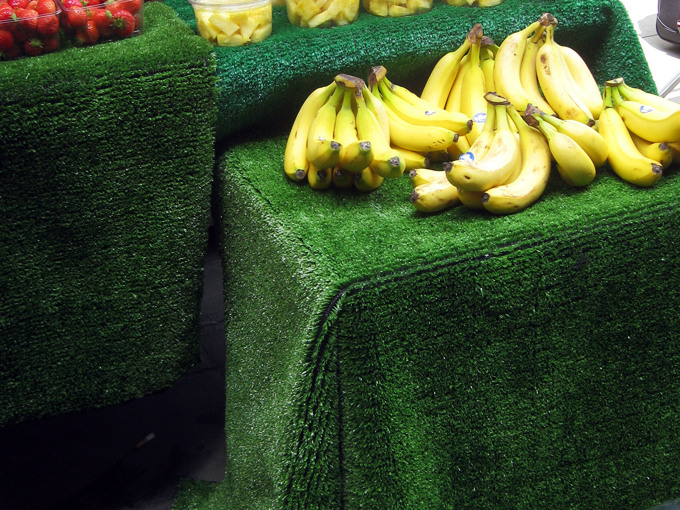
When fruit and vegetables are sold in ad hoc shops, they are most often found in the forecourt -- the space out front between the threshold and the property line.  In my neighbourhood, fruit is also sold at a number of kiosks located on the pavement by entrances to the Tube.  While not entirely ubiquitous, most shopkeepers incorporate astro turf in these displays.


Including sheets of artificial grass with fruit is tradition, I was told again and again.  It makes the fruit pop and helps craft a more natural display.  The green is eye-catching; it looks nice.  I was also told that 20 years ago, shopkeeping fashion dictated that fruit was displayed in bushel boxes.  These boxes made fruit look just carried from the fields, whereas the turf makes it look just picked. 


Although they couldn't bear a bushel, cardboard fruit boxes are often used on the grassy green surfaces to order the fruit and veg.  Another very popular strategy is the use of clear plastic mixing bowls.  Stacked and grouped with colours aligned in horizonal or vertical bands the containing fruit is often sold by the bowlful and at a discount.  "Any bowl, one pound!"  Sometimes more.


Display strategies are not merely aesthetic.  The bowls help sell fruit at a volume and create a logic for display.  Still, some vendors oppose the mixing bowls and understand that the fruit sold therein is bought from other vendors very near, or past, its expiration.  As such, some believe consumers may associate the fruit with poor quality.  I have had excellent bananas from bowls and from boxes; I reserve my judgement.  Though I must say, if you're planning guacamole, a mixing bowl of avocados may be the best bet. 

As well as softening the display and providing a contrasting colour to the fruit, astro turf also behaves like a soft curtain, hiding boxes, fruit, and crates below.

While it's easy to dismiss turf as "fake" grass, it has unexpectedly sensual qualities.  The ribbons of plastic are surprisingly soft to the touch and feel kind of, well, grassy.  It's hard not to touch them when perusing the produce.  The way the light and wind hit the sheets of turf, and "blades" of grass, also reveals wonderfully rich tones of green.  It can end up seeming quite luxurious. 


The astro turf also shows time and practice.  It wears along creases and in lines, exposing the black weave behind and eventually creating pin-striped skirts for display tables.


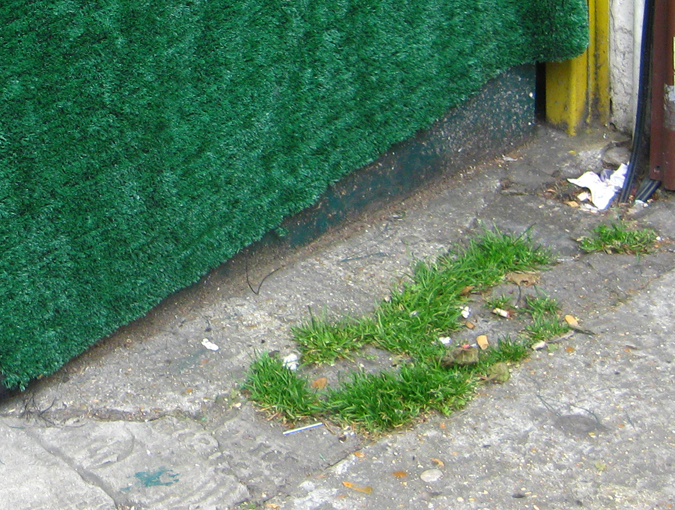
At a meeting of urban natures, juxtaposition shows that perhaps the turf is more CMYK pigment green than grass green.  The grass is always greener...?


20 June 2012

Ch-ch-ch-ch-changes

Central Perks' replaced their deli case!  The bottom image is from an earlier post.


While I did like the previous mashup and loved seeing such bold material evidence of the layers of shopkeeping, I must agree with the shopkeepers: these cases are way more effective at displaying mobile phone accessories. In case you were wondering, there are no plans to change the name.

17 June 2012

Cadburyfication

A host of corporate producers compete with each other, wooing corner shopkeepers with product and cash for the strategic shop-front placement of their branded material.  London has a long history of newspapers creating branded signage for corner shops; earlier I posted about the Lebara and Lyca campaigns for corner shop frontage.


Official Olympic sponsorship has made Cadbury particularly active in this regard, especially in the more touristy parts of my neighbourhood.  Around the British Museum, a Cadburyfication is in effect!


As well as adhering stickers along the rims of windows, hanging branded bunting, and developing new interior displays, the reps create Cadbury-branded coordinated signage for the individual shops.  Through the process, a number of options are presented to the shopkeepers for consideration.  Although these particular arrangements are designed to last through the Olympics, these relationships are long-standing and will continue after the Games. 


The economic challenges faced by many independent businesses – especially in times of economic crunch – make these arrangements particularly attractive.  And who would turn down free chocolate?!